


Trusting Your Intuition: The Switch That Shouldn't Have Turned

A Real Story About Trusting Your Intuition on a Remote Australian Gold Mine

In 2018, I was working as a short-term contractor while looking for something permanent. One job took me to a gold mine in midwestern Australia for a 10-day shutdown. Maintenance. Repairs. Tight schedule.
When we arrived, the place looked worn out. Old rusted machinery sat half-buried in grass and windblown sand. Some of it looked like it hadn't moved in years. The whole site felt like it was running on a tight budget and a bit of hope.
But we were there to work, and we got straight into it.
One of our tasks was to remove the motor drive from a conveyor, a standard job. Before touching anything, we had to isolate the power at the nearby field switch located at the electric motor. Then each of us would attach our personal danger lock. Basic safety procedure. Lock it out so no one can power it up while you're working on it.
Four of the guys clipped their locks on.
I was last.
I stood there looking at the switch. Something didn't sit right. I couldn't explain it. Nothing obvious. No sparks. No noise. Just a feeling.
Our supervisor noticed I hadn't moved.
"You okay with everything?" he asked.
I hesitated.
"I'm not sure," I said. "I've got a bad feeling. In some mines, the CCR can override field switches. I'd feel better if we confirmed directly with the control room that this isolation is effective."
He didn't argue. He said he'd check.
Ten minutes later, he came back, wide-eyed.
"You were right. The operator in the CCR says the switch is still live."
If we had gone ahead, believing the equipment was isolated, we would have been working on live machinery.
We walked to the control room together. The mine manager joined us. We traced the correct isolation point and found the proper switchboard. Once confirmed, we each hung our personal danger locks onto the verified switch.
That should have been the end of it.
But again, something felt off.
The handle on that switch didn't look like the others that had been isolated. Something about it didn't match.
I called the mine manager, who was at the far end of the switch room, and asked him to confirm the isolation. He walked over, looked, and said the switch was in the correct position.
But I wasn't convinced.
That feeling was still there. A quiet voice saying: This isn't right.
After he walked away, I carried out a safety procedure called a test for dead. If everything were truly isolated, nothing should move.
I grabbed the handle, everyone's locks attached, and tried to turn it.
It rotated.
It should have been locked solid. It should have been impossible to move. That lockout was supposed to prevent anyone from energising the circuit.
I walked out to the field, where an electrician was replacing an electric motor. He had already disconnected the wiring.
"You're lucky to be alive," I told him.
"Why's that?"
I explained what I had found in the switch room and how the isolation point had not actually been secured in a safe position.
He laughed, then told me he had also isolated the local switch out in the field. Just to be safe. Old habit.
His extra precaution likely saved his life. If he had relied solely on the main isolation, the outcome could have been very different.
What This Story Is Really About
I've worked in heavy industry for decades. Fitter and machinist. Diesel mechanic. Construction. In that world, logic rules. Procedures rule. And rightly so.
But this wasn't logic. It wasn't procedure. It was something quieter, a feeling I couldn't name that kept interrupting what I thought I knew.
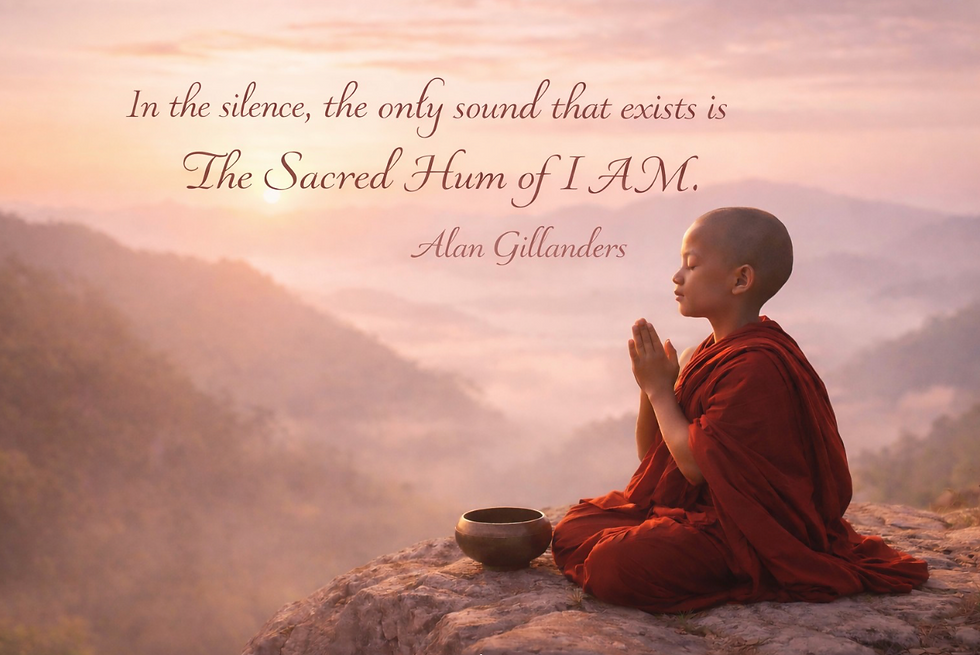
In my book, The Sacred Hum of I AM, I write about this kind of awareness. The inner intelligence that lives beneath conscious thought. The signal that doesn't shout but doesn't stop either.
Some people call it gut instinct. Some call it intuition. Some call it divine guidance. I've experienced it enough times now, in enough high-stakes situations, that I've stopped dismissing it.
Trusting your intuition isn't magical thinking. It's learning to receive information your conscious mind hasn't processed yet.
That day at the gold mine, nobody got hurt. Not because of the procedure alone. Because someone was still listening.
I've spent most of my life working with my hands. What I've learned is that the most important tool on any site isn't in your toolbox. It's the quiet voice you learn to stop dismissing.
— Alan Gillanders
Author, The Sacred Hum of I AM

Comments